You have an exciting plot and memorable characters, but first chapter mistakes can make readers lose interest before the story has a chance to develop.
A reader sampling a novel cannot know how brilliant Chapter 12 will be. The opening has to offer a voice, a situation, and a reason to continue. If it feels confusing, slow, or emotionally distant, readers may leave before the story has a chance to develop.
The good news is that many first chapter mistakes can be fixed without changing the story you intend to tell.
Understanding how to start a novel has less to do with formulas or explosive openings and more to do with giving the reader something clear and compelling to focus on.
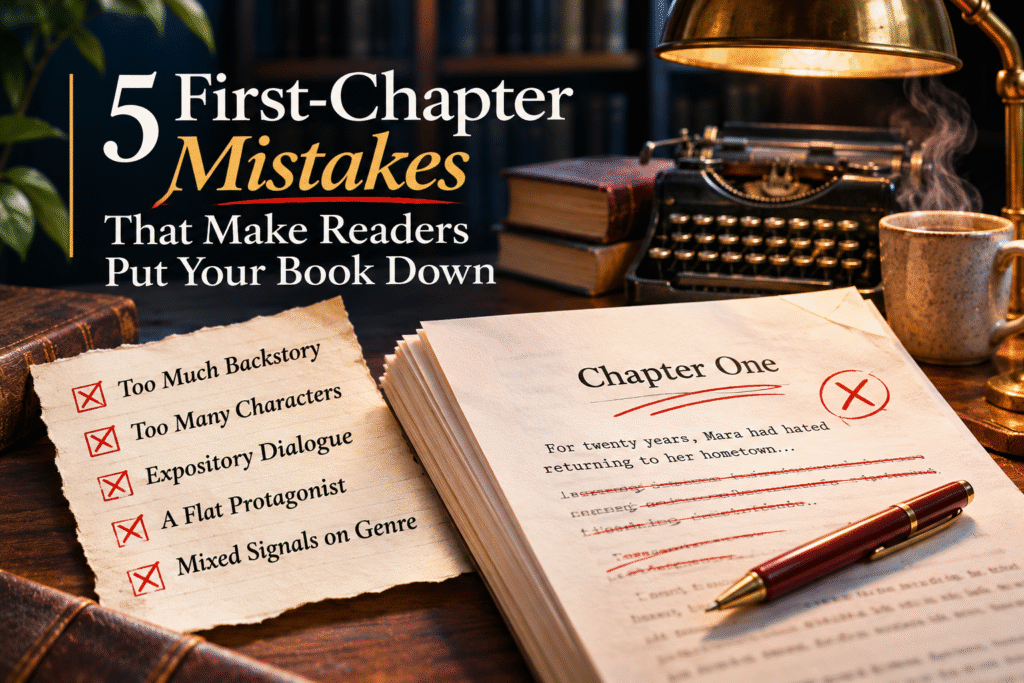
Here are five common first chapter mistakes that can weaken an otherwise promising story, along with practical ways to fix them without losing your voice.
1. First Chapter Mistakes: Starting With Backstory Instead of Story
Your protagonist has a complicated past.
You want readers to understand it, so Chapter One explains everything before the present-day story begins.
The information may be important.
Its timing may not be.
When writing a first chapter, writers sometimes confuse context with momentum.
Readers need enough information to understand a scene, but they rarely need a full biography before seeing a character make a choice.
One of the most common novel opening mistakes is asking the reader to remember the backstory before giving them a reason to care about it.
Compare these imaginary openings:
Weaker:
“For twenty years, Mara had hated returning to her hometown. Her parents had divorced when she was nine, and her brother had left three years later.”
Stronger:
“Mara had promised never to return. Then her brother’s name appeared on a missing-person poster outside the station.”
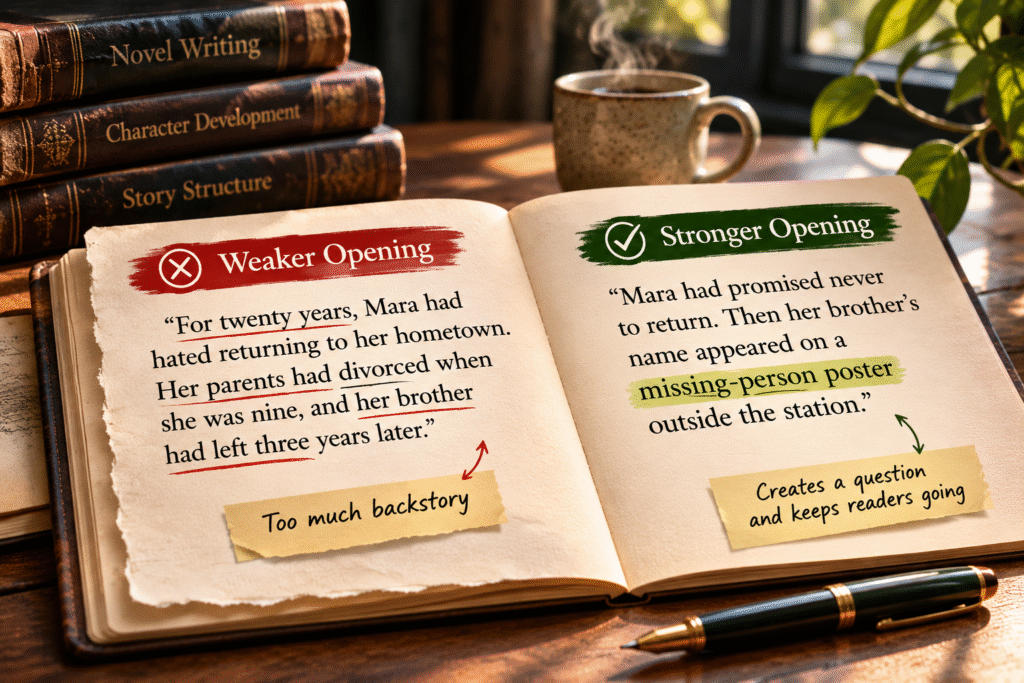
The second opening doesn’t erase the history.
It creates a question that makes the history relevant.
Readers can discover what happened to Mara’s family as the present-day problem unfolds.
How to Improve It
Start with a moment close to change, tension, or significant uncertainty.
Introduce backstory in smaller pieces when it helps explain what is happening in the present scene.
If a passage explains the past but does not change the reader’s understanding of what is happening now, consider moving it later.
These first chapter mistakes do not mean that every novel should begin with action.
A quiet literary opening can be compelling if an emotional shift, striking observation, or unresolved question draws the reader forward.
The point is movement, not noise.
2. You Introduce Too Many Characters Too Soon
A novel may require a large cast.
Its opening usually does not require an introduction to everyone.
Imagine meeting twelve people at once and being told how all of them are related.
Readers can experience the same kind of overload when too many names appear before they understand whose story matters.
This is especially common in family sagas, fantasy, and ensemble fiction.
The writer already knows the cast.
The reader does not.
One of the most useful book editing tips is to control not only how many characters appear, but also how readers are expected to understand them.
Ask:
- Does the reader need to remember this person right now?
- Does this character affect the current conflict?
- Could the introduction wait until the character has an active role?
How to Improve It
Give the opening a clear focal point.
Introduce characters who are relevant to the immediate scene and reveal them through action, distinctive choices, or meaningful interaction rather than long descriptive introductions.
Names attached to something memorable are easier to remember than names presented in a list.
When studying how to start a novel, notice how strong openings control attention.
They may hint at a larger world, but they still give readers a solid place to stand.
If a manuscript feels crowded from the beginning, professional editing and proofreading services can help identify character introductions and scenes that may work better later in the story.
3. Your Dialogue Explains Too Much and Reveals Too Little
Dialogue should sound like people speaking to one another, not like an author delivering background notes to the reader.
Imagine two siblings having this conversation:
“As you know, our father left us fifteen years ago, and you’ve been running his shop ever since.”
Both characters already know this information.
The line exists primarily to explain something to the reader, which can make the dialogue feel artificial.
However, the opposite problem can be just as damaging.
Characters may exchange pleasantries for pages without revealing tension, desire, personality, or conflict.
The conversation sounds realistic enough, but it does not earn its place in the story.
Effective dialogue reveals what characters say, what they avoid, and what they refuse to admit.
Weaker:
“I’m angry because you sold our mother’s house without asking me.”
Stronger:
“You sold the house?” Lena set the key on the table. “Did you at least keep the photographs?”
The stronger exchange communicates conflict through a specific, revealing detail.
The reader understands the emotional stakes without needing a speech that explains them.
How to Improve It
Read your opening dialogue aloud.
Remove information both characters already know unless there is a natural reason for it to be repeated.
Give each character a goal, even a small one, and let disagreement, avoidance, or subtext influence the conversation.
After each dialogue scene, ask:
What changed because this conversation happened?
For authors wondering how to hook readers, believable tension often accomplishes more than elaborate exposition.
Developmental editing can help identify dialogue scenes that stall the story, while manuscript editing can sharpen repetition, pacing, and clarity without flattening a character’s voice.
These are first chapter mistakes worth catching early because readers begin forming expectations about your dialogue almost immediately.
4. Your Main Character Gives Readers No Reason to Care
Readers do not necessarily have to like your protagonist.
They do need a reason to be interested.
A character can be selfish, unreliable, difficult, or even frightening and still hold a reader’s attention.
What matters is that the opening provides some insight into desire, vulnerability, contradiction, or consequence.
Without that connection, detailed descriptions of clothing, rooms, streets, and weather can begin to feel like a tour through a stranger’s life.
This is one of the subtler first chapter mistakes because the prose itself may be polished.
Every sentence may sound good, yet readers can still finish the scene unsure what matters to the person at its center.
Consider a character walking through a rain-soaked city.
The weather may establish atmosphere.
But if the character is crossing town to apologize before someone boards a train, every delay suddenly matters.
The rain becomes an obstacle rather than decoration.
How to Improve It
Determine what your protagonist wants in the opening scene.
Then ask:
- What stands in the way?
- What could happen if the character fails?
- Why does this moment matter to them?
You do not need to reveal the novel’s ultimate goal immediately.
A smaller, specific desire can reveal personality and create empathy.
Use description selectively.
Instead of cataloging every object in a room, show what the point-of-view character notices and why.
A daughter returning to her childhood home may ignore the expensive furniture but stop when she sees her father’s untouched coffee mug.
That detail carries emotion because it belongs to her experience.
If you’re looking for book editing tips while writing a first chapter, ask early readers one useful question:
“What do you want to know about this character next?”
Their answers can reveal whether the opening creates genuine curiosity.
Learning how to hook readers is not simply about dramatic events.
Often, it is about making one person’s experience feel consequential.
First Chapter Mistakes: 5 Reasons Readers Put Your Book Down
An opening does more than introduce the story.
It also makes a promise about the reading experience ahead.
For example, the first chapter may read like an intense horror thriller while the rest of the book develops into a cozy mystery.
Or the opening may promise a fast-paced adventure, while the next hundred pages become a slow domestic drama.
Genre blending can work beautifully.
But if the mismatch is unintentional, readers may feel misled.
Point of view, tone, pacing, and the questions introduced in the opening all contribute to this promise.
Readers may feel that their attention was misdirected if Chapter One revolves around a mystery that never matters again.
Among common novel opening mistakes, this one can easily appear when writers revise the opening in isolation.
Learning how to hook readers means making honest promises.
An exciting new opening scene may improve the first ten pages while making those pages less representative of the novel that follows.
How to Improve It
Before finalizing the opening, finish the manuscript.
Then read Chapter One alongside the ending.
Ask:
- Does the early conflict connect to the central concerns of the story?
- Does the tone reflect the reading experience that follows?
- Does the rest of the manuscript justify the expectations created in the opening?
This is where developmental editing can be particularly valuable.
Developmental editing examines the relationship between the opening, the manuscript’s overall structure, character development, pacing, and ending.
Professional manuscript editing can also help maintain consistency as revisions move scenes and reshape chapters.
How to Fix First Chapter Mistakes Without Losing Your Voice
A strong revision does not have to turn your novel into someone else’s idea of a bestseller.
It should make the experience you intended clearer and more compelling.
After reviewing these five first chapter mistakes, give your opening a focused test.
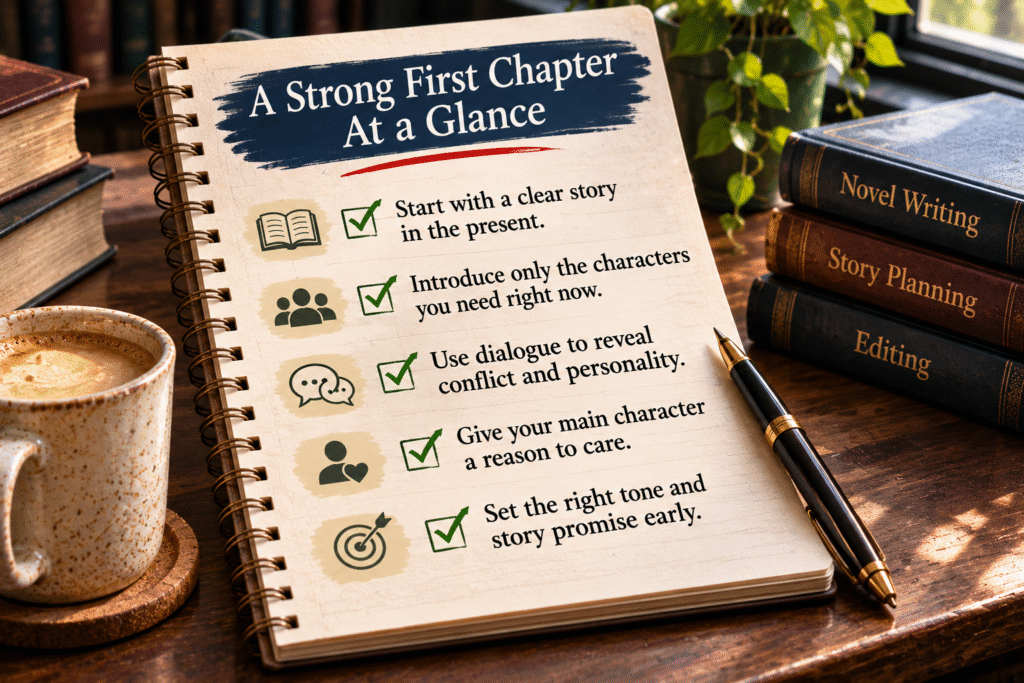
Read it without the rest of the manuscript beside you.
Then ask:
- What is changing?
- Whose experience matters?
- Why should the reader continue to the next scene?
- Is any exposition arriving before it is necessary?
- Does the dialogue reveal tension, personality, or change?
- Do the descriptions strengthen character, mood, or story?
If possible, get specific feedback from a few readers who are familiar with your genre.
Instead of simply asking whether they liked the chapter, ask where their attention was strongest, where it wandered, and what they expected to happen next.
Those responses are often more useful than a simple rating.
For authors searching for book editing tips or learning how to write and develop a novel, the most reliable principle is simple:
Invite curiosity, establish trust, and let the story unfold.
Strong openings do not tell readers everything.
They make readers want to discover more.
Give Your First Chapter the Attention It Deserves
Your opening chapter does not have to be loud, complicated, or perfect on the first attempt.
It needs to feel intentional.
Avoiding first chapter mistakes helps protect the characters, ideas, and emotional stakes you’ve worked hard to create.
At Virtue Publishing, we support authors with professional editing and proofreading services that strengthen structure, clarity, pacing, and consistency while respecting the author’s voice.
Whether you’re revising a first draft or preparing for publication, thoughtful editorial feedback can help you recognize what’s working and what still needs attention.
Ready to make your opening pages stronger?
Explore Virtue Publishing’s editorial services and find the right next step for your manuscript.