Audiobook publishing can give your book a second life by helping it reach readers who prefer listening instead of reading.
It is available in paperback, hardcover, and eBook formats.
But what about readers who haven’t picked up a physical book in months?
They may be listening instead.
Audiobooks give people another way to experience stories during long drives, evening walks, morning commutes, workouts, and everyday routines.
If your book is available only in print or digital form, you may be missing readers who prefer listening.
According to the Audio Publishers Association, U.S. audiobook sales reached $2.43 billion in 2025, reflecting continued growth in the format.
For authors willing to explore new formats, that growth represents another opportunity to connect with audiences.
But is audiobook publishing worth the investment? Can it genuinely expand your audience, and what does the process involve?
Let’s explore five reasons to turn your book into an audiobook and give your words a second life.
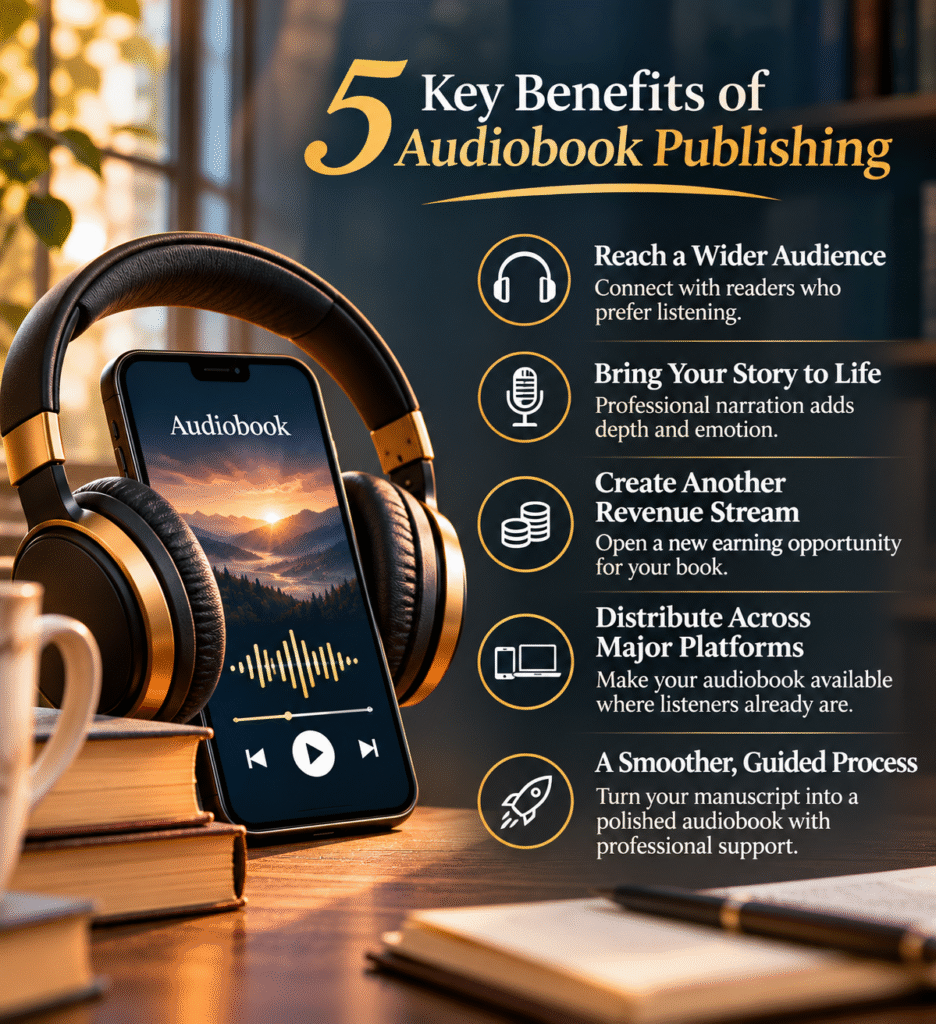
1. Audiobook Publishing Helps Your Book Reach More Listeners
Not everyone consumes books in the same way.
Some readers love turning physical pages.
Others prefer eBooks because of their convenience.
Then there are people who want to experience more books but struggle to find dedicated reading time.
This is where audiobooks become valuable.
For example, someone may find it difficult to sit down with a novel after a long workday but happily listen to several chapters during the drive home.
Another listener might experience a memoir while doing household chores or listen to nonfiction during a morning walk.
Audiobook publishing allows your story to become part of routines where traditional reading may not fit.
The Growing Audience for Audiobooks
Audiobooks continue to attract listeners who value convenience and the ability to experience books while doing other activities.
That creates an important opportunity for independent authors.
People who are already interested in your genre or subject may still be outside your current audience simply because they prefer listening.
How Audiobooks Make Your Book More Accessible
For people who find prolonged visual reading difficult, audiobooks can provide an alternative way to experience a book.
Audio does not replace accessible digital text or other accommodations, but it can make novels, memoirs, devotionals, and instructional titles available in another useful format.
If you’re researching how to turn a book into an audiobook, start by thinking about your existing audience.
Ask:
- Would your readers enjoy listening while driving or commuting?
- Does your story contain dialogue that could become more immersive through narration?
- Could your nonfiction content work well in spoken form?
- Are readers already asking for an audio edition?
If the answer is yes, exploring professional audiobook services may be a worthwhile next step.
Your readers do not always need another book.
Sometimes they simply need another way to experience yours.
2. Professional Narration Can Bring Your Story to Life
Have you ever heard someone tell a story so well that you stopped noticing everything around you?
Their pauses created suspense. Tone and delivery carried emotion, while careful timing made ordinary sentences memorable.
That is the power of a skilled storyteller.
When someone reads a printed novel, they interpret dialogue, character personalities, emotional shifts, and pacing through their own imagination.
An audiobook introduces another storytelling element: the human voice.
But delivering a compelling audiobook performance is very different from simply reading a manuscript aloud.
Why Professional Audiobook Narration Matters
Professional audiobook narration involves more than speaking clearly into a microphone.
A strong narrator considers:
- Characterization
- Emotional expression
- Pacing
- Pronunciation
- Tone
- Consistency
- Genre expectations
In fiction, narration can help distinguish dialogue and communicate shifts in mood.
In memoir, the right voice can preserve intimacy and emotional authenticity.
In nonfiction, confident and controlled delivery can make complex ideas easier to follow.
The narrator’s job is not to overpower the writing.
The voice should support it.
Imagine a suspenseful thriller narrated without changes in pace, intensity, or emotional emphasis.
Even an exciting scene could feel strangely flat.
Now imagine the same passage performed with controlled pauses, tension, and emotional awareness.
The words have not changed.
The listening experience has.
Should You Narrate Your Own Book?
Some authors choose to narrate their own memoirs, personal stories, testimonies, or specialized nonfiction.
When the author’s personal experience or expertise is central to the book, hearing their actual voice can create a strong connection with listeners.
However, self-narration still requires preparation.
Authors need to consider:
- Recording environment
- Microphone quality
- Vocal consistency
- Pronunciation
- Pacing
- Audio editing
- Technical standards
In either case, professional audiobook production can support the process through recording guidance, editing, mastering, and quality checks.
Before selecting a narrator, listen to performance samples and consider your genre, intended audience, and desired tone.
The right narrator does not replace your writing voice.
They help listeners experience it.
3. Audiobook Publishing Opens Another Revenue Opportunity
You have already invested time and resources into writing, editing, designing, and publishing your book.
So why limit its potential to only one or two formats?
Readers who prefer physical books may choose a paperback.
Digital readers may select an eBook.
Listeners may prefer an audiobook.
As a result, each format gives readers another way to purchase or access your work.
That does not mean every audiobook will become profitable.
It means audiobook publishing can create another commercial opportunity for an existing title.
How Do Authors Earn Money From Audiobooks?
Audiobook earnings depend on several factors, including:
- Distribution platform
- Contract terms
- Pricing structure
- Subscription or credit systems
- Royalty arrangements
- Territory
- Exclusivity
Some platforms sell audiobooks individually.
Others use subscription access or audiobook credits.
Before accepting distribution terms, authors should understand how compensation is calculated and how their rights are handled.
At the same time, production costs also matter.
Professional narration, recording, audio editing, mastering, and quality control all require investment.
A long novel with several narrators may require a very different production budget from a shorter nonfiction book.
Is Audiobook Production Worth the Cost?
Consider three questions before investing:
Audience demand: Are readers in your genre interested in audio editions?
Production budget: Can you afford professional production without compromising other publishing priorities?
Long-term goals: Does an audiobook support your broader author brand, future releases, or marketing strategy?
If readers are already requesting an audio version, the investment may be easier to justify.
If your book is struggling to reach readers across every format, strengthening your positioning and book marketing may need to come first.
Audiobook publishing should be part of a thoughtful publishing strategy rather than an expensive attempt to solve unrelated visibility problems.
A new format creates an opportunity, not a guarantee.
The goal is to expand your book’s potential responsibly.
4. Audiobook Publishing Can Expand Your Distribution
Creating an audiobook is only part of the process.
Making it available through appropriate listening platforms is equally important.
Authors already think about retailers and distribution when publishing print books and eBooks.
Audiobooks require the same consideration.
Depending on your chosen distributor, eligibility, territory, and agreement terms, audiobook destinations may include services such as Audible, Spotify, and Apple Books.
Understanding Audiobook Distribution
Audiobook distribution generally involves preparing and submitting:
- Completed audio files
- Audiobook cover artwork
- Book metadata
- Author and narrator information
- Pricing or distribution details
- Other platform-specific information
However, different distribution services offer different arrangements.
Some provide direct access to particular platforms, while others help distribute audiobooks across multiple retailers or library-related channels.
Not every service uses the same technical standards, royalty structures, eligibility rules, or contract terms.
Before selecting an audiobook publishing service, review:
- Distribution territories
- Retailer availability
- Exclusive or nonexclusive options
- Royalty calculations
- Payment schedules
- Rights ownership
- Contract duration
- Audio submission standards
- Procedures for updating or removing the audiobook
Why Wider Distribution Matters
Different listeners have different habits.
Some prefer purchasing audiobooks individually.
Others use subscription services.
Some borrow audiobooks through library platforms.
Making your audiobook available through multiple suitable channels can create more opportunities for discovery.
However, wider distribution does not automatically mean higher sales.
Authors still need:
- Accurate metadata
- Professional cover artwork
- Clear descriptions
- Appropriate positioning
- Effective marketing
For audiobook publishing to support long-term growth, your distribution strategy should reflect where your intended audience actually listens.
Your book deserves to be available where interested listeners are most likely to look for it.
5. Turning Your Book Into an Audiobook Is Easier With Professional Support
Turning an entire manuscript into hours of polished audio can feel overwhelming.
Where do you find the right narrator?
How do you maintain consistent recording quality?
What happens if a narrator makes an error in Chapter 12?
How do you prepare the files for audiobook retailers?
These questions are common among authors learning how to turn a book into an audiobook for the first time.
Fortunately, the process becomes easier to understand when it is divided into clear stages.
Step 1: Prepare Your Manuscript
Finalize the manuscript before recording begins.
Identify anything that may need additional guidance when spoken aloud, including:
- Unusual names
- Technical terminology
- Acronyms
- Foreign-language expressions
- Special pronunciations
- Visual references that may not translate naturally into audio
Step 2: Select the Right Narrator
Choose a narration style that fits the book’s genre, tone, and intended audience.
Professional audiobook narration should feel natural, engaging, and consistent with the author’s creative direction.
Audition samples can help determine whether a narrator is appropriate for the project.
Step 3: Record, Edit, and Master the Audio
Recording is only one part of professional audiobook production.
Audio engineers may need to:
- Remove distracting sounds
- Correct mistakes
- Adjust timing
- Maintain consistent volume
- Edit pauses
- Clean background noise
- Prepare files for platform requirements
After editing, recordings are mastered according to the technical standards of the intended distribution service.
For example, ACX has specific audio submission requirements covering file format, audio levels, recording quality, and chapter organization.
Step 4: Complete Quality Control
The finished recording should be checked against the manuscript.
Proof-listening can help identify:
- Missing passages
- Incorrect words
- Mispronunciations
- Inconsistent character names
- Editing errors
- Unwanted sounds
Even technically clean audio can contain narrative mistakes, so careful quality control is important.
Step 5: Prepare for Distribution and Launch
The final stage may include:
- Organizing audio files
- Creating audiobook cover artwork
- Preparing metadata
- Entering book and narrator information
- Submitting files for platform review
- Planning promotional content
This is also an opportunity to create marketing materials such as audiobook samples, author announcements, social content, and launch campaigns.
How Virtue Publishing Can Help
At Virtue Publishing, our audiobook publishing services are designed to help authors navigate the production process with professional support.
Our audiobook services can include narrator selection, recording, editing, mastering, and platform-ready production support. Virtue Publishing’s current audiobook service page specifically describes narration, editing, mastering, and files prepared for major audiobook retailers.
Professional support can simplify the technical side of audiobook production while helping maintain your creative direction.
Whether you are preparing an audiobook alongside your print launch, converting a memoir, or adapting an already-published novel, the process becomes easier when each stage is handled systematically.
You focus on the story you created.
The production process helps prepare that story for listeners.
Final Thoughts: Your Book’s Story Doesn’t Have to End on the Page
Your manuscript may have started as words on a screen, but it does not have to remain limited to printed or digital pages.
Audiobooks give authors another way to introduce their work to audiences, explore additional publishing opportunities, and create a different storytelling experience.
With thoughtful planning, professional audiobook narration, and an appropriate distribution strategy, your book can become something readers experience even when traditional reading is not practical.
Your audience, budget, and publishing goals should still guide the decision.
No format guarantees commercial success, and not every book necessarily needs an audiobook.
But if your readers are listening, giving them the opportunity to hear your story may be worth considering.
Your Story Is Written. Now Let It Be Heard.
At Virtue Publishing, we help authors transform written manuscripts into professionally produced audiobooks through narration, audio production, mastering, and publishing support.
Whether you are ready to explore audiobook publishing or simply want to understand your options, our team can help you determine an appropriate approach for your book.
Explore Virtue Publishing’s Professional Audiobook Services
Your book has already found its words.
Now give those words a voice.