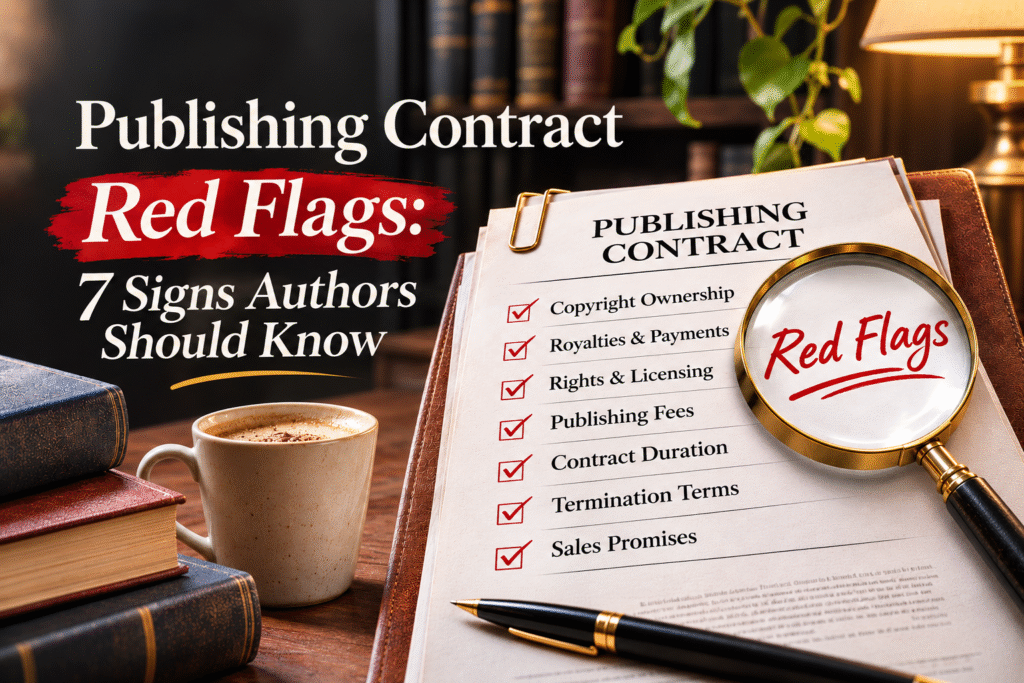
Publishing contract red flags can be easy to miss when you’re excited to publish your book, especially if the agreement looks professional and the opportunity feels urgent.
You wrote the book. The story is yours. But does that automatically mean you will still control it after signing a publishing contract?
Not always.
Imagine spending years refining your manuscript, investing thousands in publication, and then discovering that you cannot make certain decisions about your own work.
This can happen when authors sign agreements without fully understanding what they are accepting.
Some publishing agreements restrict creative control, grant publishers broad rights, or fail to explain important financial terms clearly. In the excitement of getting published, first-time authors may overlook warning signs that deserve closer attention.
Before handing over your manuscript or your money, understanding publishing contract red flags can help protect your work, finances, and publishing future.
Here are seven warning signs every author should recognize before signing.
1. Publishing Contract Red Flags Around Book Ownership
One of the most serious publishing contract red flags involves uncertainty about copyright ownership.
According to U.S. law, the author is generally the original copyright owner of a book they create.
However, your control over particular rights may change when you sign a publishing agreement.
This is where things become more complicated.
Traditional publishers often require exclusive licenses to publish and distribute a book. These arrangements are not automatically red flags. They are a normal part of many traditional publishing agreements.
The important distinction is between transferring full copyright ownership and licensing specific publishing rights.

Red Flag #1: The Publisher Wants Complete Copyright Ownership
If a publisher asks you to transfer all copyright ownership without providing a clear explanation, proceed carefully.
A full transfer may affect your ability to authorize future editions, adaptations, translations, or other uses of your work.
Before signing a publishing agreement, understand whether you are transferring ownership or granting a license.
Ask yourself:
- Will I retain copyright ownership?
- Which publishing rights am I granting?
- Does the agreement include print, eBook, and audiobook editions?
- Can I authorize translations or film adaptations independently?
- What happens to my rights if the publishing relationship ends?
A professional publisher should be able to explain these provisions clearly.
Remember: Publishing your book and surrendering ownership of your intellectual property are not the same thing.
Understanding author rights is essential to maintaining control over your literary work.
2. The Publisher Isn’t Transparent About Royalties
You wrote the manuscript.
You invested the time, effort, and creativity.
Naturally, you should understand how you will be paid.
Yet financial terms are among the most commonly misunderstood parts of a book publishing contract.
Some authors hear an attractive royalty percentage and sign without understanding what that percentage is actually based on.
Receiving 60% of net receipts, for example, is not necessarily the same as receiving 60% of the book’s retail price.
Printing, distribution, retailer discounts, returns, and other permitted deductions may affect the amount used to calculate royalties.
Red Flag #2: Royalty Calculations Are Unclear
Be cautious when an agreement promises appealing book royalties but does not clearly explain how they are calculated.
A trustworthy publishing agreement should identify:

- How royalties are calculated
- Which deductions apply
- When payments are issued
- How sales are reported
- Whether different formats carry different royalty rates
- How returns and refunds affect earnings
Consider a simple example.
A paperback sells for $15. If the applicable royalty is 50% of $6 in qualifying net receipts, the author receives $3, not $7.50.
That difference matters.
Red Flag #3: You Can’t Verify Your Sales or Earnings
Another warning sign is a publisher that refuses to provide meaningful sales statements or explain its reporting process.
Authors should understand what financial documentation they will receive and whether the agreement provides an appropriate way to review relevant information.
There should not be unnecessary mystery surrounding book royalties.
Even when a publisher manages sales and distribution, financial transparency remains important.
Before signing, ask:
- What information will appear in royalty statements?
- How frequently will statements be provided?
- How are returns handled?
- Is there a process for reviewing relevant financial records?
Clear financial reporting is not an unreasonable request.
It is part of a professional publishing relationship.
Understanding these publishing contract mistakes early can help prevent confusion, disappointment, and potentially expensive disputes later.
3. You’re Being Pressured to Sign or Pay Immediately
Imagine this.
A publishing company receives your manuscript.
Within days, someone congratulates you and tells you your book has enormous potential.
Then comes the catch.
You are told that you must sign immediately and make a large payment or risk losing an exclusive opportunity.
Praise can be exciting.
But enthusiasm should never replace careful evaluation.
Pressure tactics are among the publishing contract red flags authors should take seriously.
Red Flag #4: You’re Given No Time to Review the Agreement
A company that insists you sign before you have had a reasonable opportunity to understand the terms deserves additional scrutiny.
Legitimate publishing opportunities may have deadlines, but authors should still have enough time to understand their obligations and seek independent advice when necessary.
Be especially cautious when someone:
- Demands immediate payment without clearly explaining the services
- Discourages consultation with an attorney or literary advisor
- Refuses to provide a complete written agreement
- Changes pricing after making verbal promises
- Uses unrealistic deadlines to create pressure or anxiety
These behaviors can also appear in book publishing scams, where an author’s desire to become published is exploited.
Red Flag #5: Publishing Fees and Deliverables Aren’t Clearly Defined
Not every publisher or publishing service that charges authors is dishonest.
Self-publishing service providers and some hybrid publishers may charge authors for specific professional services, while traditional publishers generally operate differently.
Problems arise when fees are hidden, services are misrepresented, or the business cannot clearly explain what the author is purchasing.
A legitimate paid service should clearly define:
- Deliverables
- Timelines
- Revision policies
- Payment terms
- Additional charges
- Responsibilities of both parties
Request a detailed written breakdown before making a payment.
Understanding the differences between publishing models can help authors distinguish legitimate professional support from potential book publishing scams.
A publishing opportunity should withstand reasonable questions.
If asking for clarity creates pressure, reconsider the relationship.
For authors comparing different publishing approaches, Virtue Publishing’s book publishing services outline the professional support that can be involved in bringing a manuscript to market.
4. Publishing Contract Red Flags Around Author Rights
You should not have to wonder what will happen to your book five years after signing a publishing agreement.
Many authors naturally focus on publication dates, editing, and cover design.
But the long-term effects of an agreement can be just as important.
Some contracts grant publishers exclusive rights across multiple formats, languages, or territories.
Others may limit an author’s ability to republish or reuse their work.
These terms are not automatically unfair.
However, they should be clearly defined and appropriate for the publishing arrangement being offered.
Red Flag #6: Your Rights Have No Clear Limitations or Return Conditions
One of the most important publishing contract red flags is an agreement that gives a publisher extensive control without clearly explaining when or how those rights may eventually return to the author.
For example, imagine granting exclusive publishing rights to your book.
Years later, the publisher is no longer actively promoting or selling the title, but the agreement still prevents you from publishing another edition.
Without an appropriate rights-reversion provision, regaining control may become difficult.
Review the following carefully:
Exclusivity: Can you publish the same work elsewhere during the agreement?
Territory: Does the publisher control distribution worldwide or only within specified markets?
Formats: Are paperback, hardcover, eBook, and audiobook rights included?
Duration: How long does the agreement remain in effect?
Termination: Under what circumstances can either party end the relationship?
Rights Reversion: When and how can publishing rights return to you?
The Authors Guild specifically emphasizes the importance of clearly defined rights grants and workable reversion provisions.
Understanding these author rights can help you make informed decisions about future editions, distribution opportunities, and adaptations.
Copyright ownership and publishing rights are closely connected, but they are not interchangeable.
You may retain copyright ownership while granting a publisher exclusive rights to specific uses of your book.
That is why reviewing only the copyright clause is not enough.
Authors should understand the entire publishing agreement, including what happens if their circumstances or publishing goals change.
5. The Publisher Makes Promises It Can’t Guarantee
Every author wants their book to succeed.
Bestseller lists. Bookstore displays. Interviews. Thousands of readers discovering their work.
Unfortunately, some companies take advantage of those ambitions by making promises they cannot realistically guarantee.
Promises of guaranteed commercial success are among the clearest publishing contract red flags.
Red Flag #7: You’re Promised Bestseller Status or Guaranteed Sales
Be cautious when a company claims it can guarantee that your book will become a bestseller, sell a specific number of copies, or receive major media attention.
Professional book marketing can improve visibility and create opportunities, but no publisher or marketing company can guarantee how readers will respond.
Likewise, making a book available for purchase does not automatically guarantee placement on physical bookstore shelves.
Authors researching book publishing scams should pay close attention to claims that sound impressive but lack specific, verifiable commitments.
Compare these two statements:
“Your book will be available for ordering through participating retail distribution channels.”
And:
“Your book is guaranteed to appear on bookstore shelves nationwide.”
The first describes a distribution opportunity.
The second makes a much stronger promise that would require clear evidence and contractual commitments.
How to Evaluate Publishing Promises
Before accepting marketing or distribution claims, ask:
- What services will actually be delivered?
- Are promotional placements guaranteed or simply proposed?
- Does the publisher provide a realistic marketing plan?
- Are sales projections clearly identified as estimates?
- Can the company explain its publishing and distribution relationships?
Watch for vague promises such as:
- Guaranteed exposure
- Instant bestseller
- Unlimited sales potential
- Guaranteed national placement
Publishing success depends on many factors, including manuscript quality, market demand, genre, reader engagement, pricing, distribution, and promotion.
No single business controls all of those variables.
The most trustworthy publishing partners prioritize transparency, realistic expectations, and clearly defined services over exaggerated promises.
By identifying these publishing contract mistakes, authors can focus their resources on genuine opportunities rather than unrealistic claims.
Final Thoughts: Protect Your Book Before You Publish It
Writing a book requires imagination, persistence, and countless hours of work.
Protecting it deserves the same level of attention.
Understanding publishing contract red flags is not about assuming that every publisher has bad intentions.
It is about recognizing that contracts determine important parts of your professional publishing relationship.
A well-structured book publishing contract should clearly explain:
- The services being provided
- Payment responsibilities
- Book royalties
- Copyright ownership
- Publishing rights
- Author responsibilities
- Termination conditions
Before signing, read every clause carefully, ask questions, and seek qualified legal guidance when necessary.
Publishing contract mistakes can affect an author long after the book’s release.
Your manuscript represents your creativity.
Your publishing agreement should reflect the importance of protecting it.
Publish With Confidence. Protect What You’ve Created.
At Virtue Publishing, we believe authors deserve clarity, transparency, and meaningful control throughout their publishing journey.
Our author-focused publishing services allow writers to retain ownership of their work while receiving professional support throughout the publishing process.
That support can include editing and proofreading, professional book cover design, formatting, publishing, distribution, and marketing.
Whether you are publishing your first novel, preparing a memoir, or bringing a nonfiction manuscript to market, understanding your options is an important first step toward making confident decisions.
Ready to explore your publishing options?
Explore Virtue Publishing’s Publishing Services
Because getting published should be an exciting milestone, not a decision that leaves you wondering who controls your book.