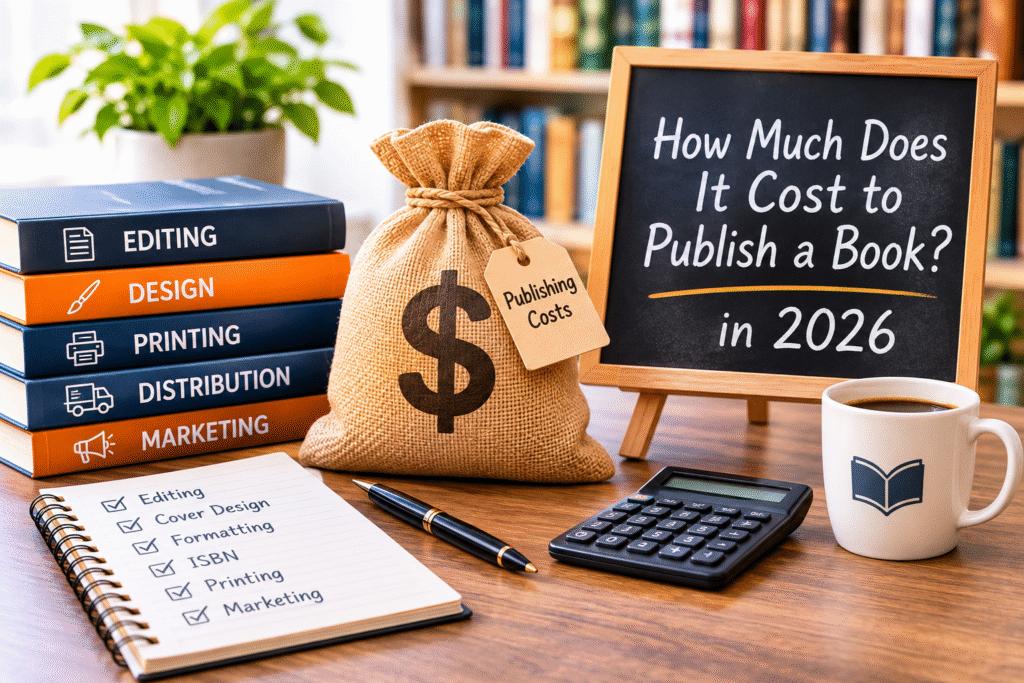
You’ve spent months, perhaps years, writing your book. But how much does it cost to publish a book in 2026?
Some say self-publishing is free. Others estimate $500 to $10,000 or more. The truth? Book publishing costs depend on your genre, publishing goals, and the professional services you need.
While uploading a manuscript to Amazon can be free, producing a professionally edited, beautifully designed, and properly distributed book often requires an investment.
So, what should you budget for book editing, cover design, formatting, distribution, and marketing? Which expenses are essential, and where can you save without sacrificing quality?
Let’s break down the real cost of publishing a book in 2026.
How Much Does It Cost to Publish a Book in 2026?
Here’s the short answer: you can self-publish a book for free using certain publishing platforms, but professional preparation can cost several thousand dollars.
According to Reedsy’s 2026 analysis of freelance publishing quotes, professional self-publishing services commonly total approximately $2,940 to $5,660, depending on the services required.
That figure is a useful benchmark, not a universal publishing price.
A short, carefully edited nonfiction book may cost substantially less to prepare than a 120,000-word fantasy novel. An illustrated children’s book brings an entirely different set of expenses.
Most importantly, there’s a distinction between paying to “publish” a book and paying to “prepare it for publication”.
Platforms such as Amazon Kindle Direct Publishing (KDP) allow authors to upload books without an upfront publishing fee. However, editing, professional design, formatting, illustrations, printing, and marketing can involve additional costs.
The real question isn’t simply how cheaply you can publish.
It’s how much you need to invest to produce the book your readers deserve.
1. Book Editing Costs: Where Quality Begins
Estimated professional cost: approximately $0.01–$0.05 per word, depending on the editing service.
Imagine buying a novel with a beautiful cover, only to discover awkward dialogue, inconsistent character names, repetitive paragraphs, and spelling mistakes within the first few chapters.
Would you keep reading?
More importantly, would you recommend that book to someone else?
Professional book editing is one of the most consequential investments an author can make, because presentation alone cannot compensate for a manuscript that isn’t ready.
When authors ask how much does it cost to publish a book, editing is often one of the biggest variables in the final budget.
However, not every book requires the same level of editing.
Developmental Editing: Improving the Bigger Picture
Developmental editing looks beyond individual sentences. It examines the foundation of your manuscript.
For fiction, this can mean strengthening character development, pacing, plot consistency, and narrative structure. For nonfiction, it may involve reorganizing chapters, improving arguments, identifying gaps, and strengthening the overall reader experience.
On professional freelance marketplaces, developmental editing can cost roughly $0.026–$0.053 per word, though quotes vary.
Copyediting: Refining the Writing
Copyediting focuses on clarity, grammar, consistency, sentence structure, and readability.
A good copyeditor doesn’t simply correct mistakes. They help your writing communicate more effectively while protecting your voice and intended meaning.
Proofreading: The Final Quality Check
Proofreading comes near the end of production, after the manuscript has been edited and formatted.
Its purpose is to catch remaining typographical errors, punctuation problems, and inconsistencies before readers encounter them.
Where should you spend your money?
Start by assessing your manuscript rather than automatically purchasing every available editing service. A relatively polished manuscript might need copyediting and proofreading, while a first draft with significant structural problems could benefit from developmental editing first.
The objective is not to purchase the greatest number of services. It’s to give your book the specific editorial attention it needs.
2. Professional Book Cover Design: Your First Impression Has a Price
Typical marketplace benchmark: around $930 for a professional custom cover, with significant variation.
Readers may be told not to judge books by their covers, but covers remain one of the first things they encounter when browsing online bookstores.
Before reading your description, checking your reviews, or opening your first chapter, potential buyers see a thumbnail.
In that moment, your cover needs to communicate something important: genre, tone, professionalism, and the type of reading experience they can expect.
That’s why professional book cover design is more than an aesthetic decision.
What Influences Book Cover Design Costs?
Several factors determine how much an author pays:
Design Complexity: A minimalist typographic cover generally requires a different production process than a detailed fantasy illustration.
Custom Artwork: Commissioned illustrations and licensed imagery may increase costs.
Book Formats: Paperback and hardcover editions require complete cover layouts, including spine and back cover specifications.
Designer Experience: Experienced book designers may charge more for their expertise in genre conventions and retail presentation.
Revisions & Deliverables: The number of concepts, revisions, and final file formats can affect pricing.
Some authors choose economical premade designs. Others commission entirely original artwork.
Neither route guarantees commercial success.
What matters is whether the final cover fits your book, communicates professionally, and works across the platforms where readers will encounter it.
For a deeper explanation, explore our guide to
https://virtuepublishing.com/professional-book-cover-design/
3. Book Formatting and Interior Design Costs
Estimated cost: $0 for DIY formatting tools, or several hundred dollars and upward for professional services.
A manuscript that looks perfectly organized in Microsoft Word can look considerably different when converted into a paperback, hardcover, or eBook.
Margins shift. Paragraphs break unexpectedly. Chapter openings become inconsistent. Tables and illustrations may not behave as intended.
Book formatting, also called interior design or typesetting, ensures that your manuscript becomes a comfortable, readable, publication-ready product.
Print Formatting vs. E-Book Formatting
Print books require careful attention to trim size, margins, gutters, page numbering, typography, and the placement of headers and chapter breaks.
E-Books need layouts that adapt to different screen sizes, font settings, and reading devices.
A straightforward novel is generally less complicated to format than a cookbook containing photographs, a textbook with tables, or an illustrated children’s book.
Free tools can work well for simple layouts. Professional formatting becomes particularly valuable when a book has complex design requirements or needs consistent presentation across multiple editions.
A beautifully written book should also be comfortable to read.
Good formatting might not attract much attention when it’s done correctly. Poor formatting, however, can distract a reader on almost every page.
4. ISBN Costs and the Cost of Publishing a Book
U.S. ISBN pricing: $125 for one ISBN or $295 for a block of ten through Bowker, based on listed prices.
An ISBN, or International Standard Book Number, identifies a particular edition and format of a book.
If you’re planning to publish multiple editions, understanding ISBN requirements early can prevent unnecessary expenses and confusion.
For example, a paperback and hardcover generally require separate ISBNs. Different editions may also need distinct identifiers.
Amazon KDP offers free ISBNs for eligible print books, but those identifiers come with restrictions on publisher identification and use.
Purchasing your own ISBN gives you more control over your publishing identity and how that edition is registered.
For authors planning multiple books or formats, buying ISBNs in a block can reduce the average cost per identifier.
Before purchasing, consider where you intend to publish, which formats you need, and whether maintaining your own publishing imprint matters to you.
5. Amazon KDP vs. IngramSpark: What Does Distribution Cost?
Getting a book published and getting it distributed are related, but they are not the same thing.
You might publish a paperback successfully on Amazon while also wanting it available for bookstores, libraries, and other retailers.
Your distribution strategy should reflect those goals.
Amazon Kindle Direct Publishing
Amazon KDP allows authors to publish eligible eBooks, paperbacks, and hardcovers without paying an upfront listing or publication fee.
For print books, KDP generally uses print-on-demand technology. Instead of ordering hundreds of copies beforehand, the book is printed when a customer purchases it.
Printing costs are factored into the royalties earned from each sale.
The amount depends on specifications such as page count, trim size, paper type, and whether the interior uses black or color ink.
This makes KDP accessible to authors who don’t want to invest heavily in inventory.
IngramSpark and Wider Distribution
IngramSpark is another print-on-demand and distribution option, particularly useful for authors who want to make their books orderable through a broader retail and library network.
However, distribution availability does not guarantee that bookstores will stock your book.
Retail discounts, return settings, printing costs, shipping, and the economics of wholesale orders all influence your potential earnings.
Authors should examine current platform terms and calculate the expected profit per copy before deciding where and how to distribute.
Our Amazon KDP vs. IngramSpark guide explores the differences in more detail.
6. Book Marketing Costs in Your Publishing Budget
Potential budget: from minimal organic promotion to thousands of dollars for professional campaigns.
Here’s a situation many first-time authors encounter.
After months of preparation, their book finally goes live. They share the Amazon link with friends and family, make a few social media posts, and wait for sales.
A week passes.
Then another.
The book is available, but very few people seem to know it exists.
This is where the distinction between publishing and marketing becomes important.
Publishing makes your book available. Marketing helps potential readers discover it.
A professional book marketing strategy may include:
Author Website
An author website gives readers, journalists, booksellers, and potential collaborators a central place to learn about you and your work.
It can feature your biography, books, reviews, contact information, and newsletter registration.
Social Media Marketing
Social media allows authors to share excerpts, introduce their books, discuss relevant themes, and develop relationships with their target audience.
The most effective content goes beyond repeatedly asking people to buy a book.
It gives them a reason to become interested.
Book Launch Campaigns
A planned launch may involve advance reader copies, early reviews, promotional content, email campaigns, author interviews, and carefully timed announcements.
Bookstore and Podcast Outreach
Depending on genre and audience, independent bookstores, libraries, podcasts, and relevant media outlets may offer additional opportunities for exposure.
However, outreach does not guarantee coverage, stocking, interviews, or events.
Paid Advertising
Amazon Ads and Meta advertising can help introduce books to targeted audiences.
Yet advertising should be approached strategically. Spending money on clicks without a compelling book description, appropriate cover, strong positioning, and clear audience can quickly exhaust a budget.
For first-time authors, an effective approach is to begin with a realistic launch plan and expand spending based on measurable results.
7. How Much Does It Cost to Publish a Book? Sample Budgets for First-Time Authors
How do these individual expenses come together?
The following examples illustrate three possible approaches for a text-heavy book. They’re planning scenarios, not guaranteed market quotes or Virtue Publishing package prices.
Understanding how much does it cost to publish a book becomes easier when the major expenses are viewed together.
| Expense | Lean DIY Budget | Supported Publishing | Expanded Launch |
|---|---|---|---|
| Editing & Proofreading | $300 | $1800 | $3500 |
| Cover Design | $100 | $700 | $1100 |
| Formatting | $0 | $350 | $650 |
| ISBNs | $0 | $125 | $125 |
| Marketing | $100 | $500 | $1500 |
| Estimated Total | $500 | $3475 | $6875 |
The lean example assumes substantial work is completed by the author, with limited paid support. Its editorial allowance may not be sufficient for full professional editing of a novel.
The supported scenario includes more professional involvement, while the expanded example allows greater investment in editorial preparation, production, and promotion.
None includes substantial commissioned illustration, ghostwriting, large print orders, or complex research and permissions work.
A children’s picture book or heavily illustrated nonfiction title could have a very different budget.
The important lesson is that there is no single correct amount to spend on publishing a book.
There is only the budget that makes sense for your manuscript, your audience, and your goals.
8. Hidden Book Publishing Costs You Should Know About
An inexpensive publishing quote can become expensive if essential services are excluded.
Before signing an agreement, ask exactly what you’re paying for.
Watch for these frequently overlooked expenses:
- Additional editing or revision rounds.
- Separate eBook, paperback, and hardcover formatting.
- Copyright permissions or image licensing.
- Author copies, printing, and shipping.
- ISBN registration and publishing setup.
- Cover adjustments for different platforms or print specifications.
- Website hosting and ongoing marketing expenses.
- Distribution-related costs and royalty deductions.
It’s equally important to understand who controls your publishing accounts, book files, ISBNs, and intellectual property.
An author should never have to guess what rights they retain, how royalties are calculated, or which services are included in an agreement.
A trustworthy publishing process should make the details clearer, not harder to understand.
9. How Much Does It Cost to Publish a Book Without Professional Help?
Yes.
For an author willing to learn formatting software, manage publishing accounts, create promotional material, and perform much of the production work independently, costs can be reduced substantially.
Free tools and print-on-demand services have made publishing more accessible than ever.
But free publishing tools do not necessarily mean professional publishing results.
Consider what happens when you save money by skipping a service that your manuscript genuinely needs.
A weak cover might struggle to communicate the right genre. Inconsistent editing may affect reader confidence. Poor formatting may make an otherwise engaging book difficult to read.
At the same time, spending more does not automatically produce a better book or more sales.
The smartest approach is to identify which parts of the process you can manage confidently and which require specialized expertise.
You don’t need the most expensive publishing plan.
You need the right one.
10. How Much Does It Cost to Publish a Book With Professional Help?
For some authors, managing everything independently is part of the appeal.
For others, coordinating editors, designers, formatters, printing specifications, retailer accounts, and launch activities becomes overwhelming.
This is where professional publishing support can provide value.
Rather than sourcing and managing each service separately, authors can work with a team that helps coordinate the different stages of production.
At Virtue Publishing, our approach begins with understanding the manuscript and the author’s goals.
Some books need comprehensive editorial development. Others are nearly ready for publication and primarily need professional formatting, cover design, or distribution assistance.
We support authors through services including manuscript editing, book cover design, formatting, publishing, distribution, and book marketing.
Just as importantly, our publishing approach is designed to preserve author ownership and creative control. Authors retain their rights while receiving professional assistance tailored to their projects.
The goal isn’t simply to upload a book.
It’s to help an author move from manuscript to a professionally presented publication with a clear understanding of the process.
Frequently Asked Questions About Book Publishing Costs
Is it free to publish a book on Amazon?
Yes. Amazon Kindle Direct Publishing allows eligible authors to publish eBooks and print books without an upfront publishing fee. Optional professional services may cost extra, and print production costs are deducted when calculating print royalties.
How much does it cost to self-publish a 200-page book?
The cost depends more on the manuscript’s word count, condition, design complexity, and required services than its page count alone. A simple DIY publication can cost very little, while professionally edited and designed editions may require several thousand dollars.
Do I need to pay a publisher to publish my book?
Not necessarily. Traditional publishers generally pay the costs of producing books they acquire, while independent authors may pay for their own production services. A paid publishing service is different from a traditional publishing contract, so review the business model and agreement carefully.
What is the most expensive part of self-publishing?
For many text-heavy manuscripts, professional editing is among the largest expenses. Books requiring extensive custom illustrations, specialist research, ghostwriting, or large marketing campaigns may have different cost drivers.
Can I make money from a self-published book?
Yes, but profitability depends on pricing, royalties, production costs, marketing expenses, and the number of copies sold. Neither professional publishing services nor marketing campaigns can guarantee sales.
Final Thoughts: Invest in the Book, Not Just the Publishing Process
Writing a book is an achievement. Publishing it is a decision about how you want that work to enter the world.
You can spend very little and take the independent route. You can invest in individual professional services. Or you can work with a publishing team that helps you navigate the entire process.
Each option comes with advantages, responsibilities, and costs.
What matters most is understanding those choices before you spend your money.
Ultimately, the answer to how much does it cost to publish a book depends on the manuscript, production choices, and level of professional support required.
Because the real value of professional publishing isn’t measured by the number of services on an invoice. It’s measured by whether those services genuinely improve your book and prepare it for the readers you hope to reach.
Your manuscript deserves a publishing plan as thoughtful as the work you’ve put into writing it.
Ready to Find Out What Publishing Your Book Could Cost?
Every book is different, and your publishing budget should reflect that.
At Virtue Publishing, we help authors understand what their manuscripts need, explore their publishing options, and build a practical path toward publication.
Whether you’re preparing your first novel, completing a memoir, or planning a nonfiction release, we’re here to help you make informed decisions.
Get a Personalized Publishing Quote (https://virtuepublishing.com/)
Tell us about your book, your publishing goals, and where you are in the process. We’ll help you identify the next steps.