
You can spend months or even years writing a book, developing characters, refining ideas, and building a story you believe in. However, even a strong manuscript can lose readers if hidden editing problems remain in the final version.
Professional manuscript editing helps authors identify issues that are difficult to notice when reviewing their own work. These problems may involve pacing, point of view, dialogue, consistency, grammar, sentence structure, or factual details.
Some mistakes may seem small, but together they can affect readability, reader trust, reviews, and ultimately book sales.
This guide explains seven common manuscript mistakes, why authors often miss them, and how professional book editing can help prepare a manuscript for publication.
Why Authors Often Miss Problems in Their Own Manuscripts
Writers become extremely familiar with their own work.
After reading the same chapters repeatedly, your brain begins to anticipate what comes next. You may understand a character’s motivation because you created it, even when that motivation is not completely clear on the page.
This familiarity can create editing blind spots.
You may unintentionally overlook:
- Missing information
- Repetitive sentences
- Inconsistent character details
- Timeline problems
- Weak transitions
- Unclear dialogue
- Slow pacing
- Grammar mistakes
This does not mean the manuscript is poorly written. It simply means authors are often too close to their own work to evaluate every detail objectively.
That is one reason professional manuscript editing can be so valuable before publication.

1. Pacing Problems That Cause Readers to Lose Interest
Pacing determines how quickly or slowly a story or argument develops.
If a section moves too slowly, readers may become bored. If important moments move too quickly, readers may not have enough time to understand or emotionally connect with what is happening.
For fiction, pacing problems may include:
- Long scenes where little happens
- Excessive backstory
- Repetitive dialogue
- Important events happening too quickly
- Chapters that do not move the story forward
For nonfiction, pacing problems can appear when chapters contain too much explanation, repeat the same ideas, or delay the information readers are expecting.
A professional editor looks at the manuscript as a complete reading experience and identifies where sections should be tightened, expanded, reordered, or clarified.
2. Point-of-View Inconsistencies
Point of view determines who is telling the story and what information the reader can access.
One of the most common fiction editing problems occurs when the narrative unexpectedly shifts between characters or perspectives.
For example, a scene may begin from one character’s perspective and suddenly reveal another character’s private thoughts without a clear transition.
These shifts can confuse readers and weaken immersion.
During manuscript editing, an editor can identify inconsistent point-of-view changes and recommend ways to keep the narrative perspective clear and controlled.
For nonfiction, consistency is also important. The tone and perspective should remain appropriate for the intended audience throughout the book.
3. Passive Voice and Weak Sentence Construction
Passive voice is not automatically incorrect, but excessive use can make writing feel distant, slow, or less engaging.
Compare:
Passive:
The decision was made by the committee.
Active:
The committee made the decision.
The second sentence is usually clearer and more direct.
Professional book editing does not mean removing every passive sentence. Instead, the goal is to identify where sentence construction weakens clarity, energy, or readability.
Editors also look for:
- Unnecessarily long sentences
- Repetitive sentence structures
- Awkward phrasing
- Excessive filler words
- Unclear references
- Wordy explanations
Small sentence-level improvements can significantly improve the reading experience.
4. Dialogue That Sounds Unnatural
Dialogue should sound natural while still serving the story.
A common mistake is writing conversations exactly as people speak in everyday life. Real conversations often contain repetition, filler words, unfinished thoughts, and unnecessary information.
Good fictional dialogue is more focused.
Problems may include:
- Characters explaining information they would already know
- Every character sounding the same
- Dialogue that is too formal
- Excessive small talk
- Repetitive dialogue tags
- Conversations that do not move the story forward
A professional editor can help preserve each character’s voice while improving clarity, rhythm, and purpose.
Dialogue should feel natural without becoming unnecessary.
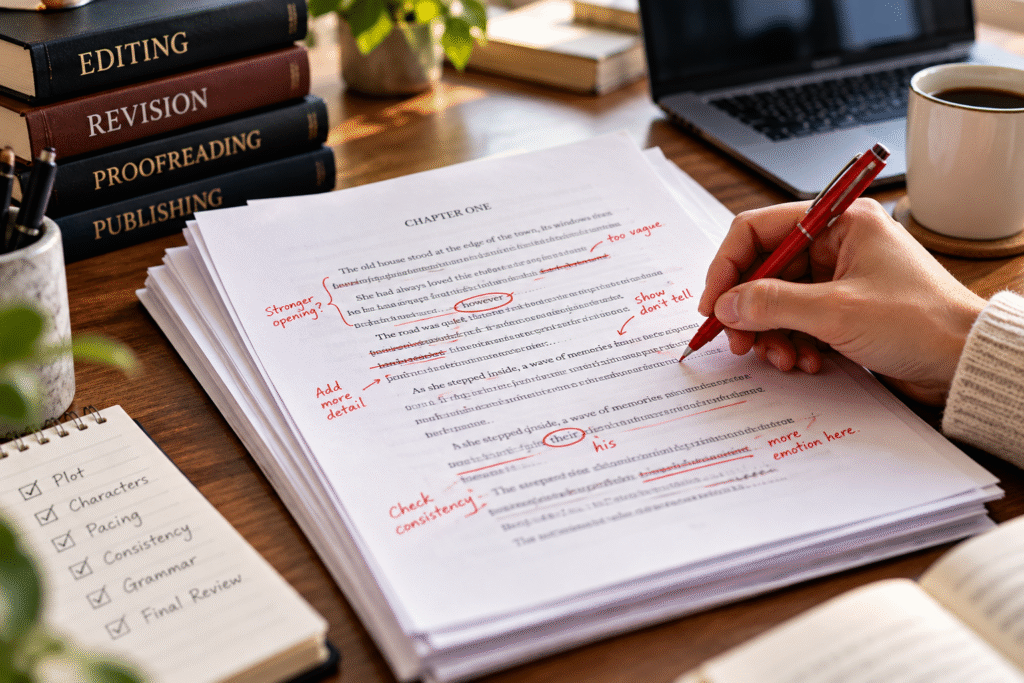
5. Inconsistent Facts, Characters, and Timelines
Consistency errors can quickly damage reader trust.
For example, a character may have blue eyes in one chapter and brown eyes later. A location may suddenly change. A date may conflict with an earlier event. A nonfiction statistic may be presented differently in two sections.
These mistakes are easy for authors to overlook, especially in longer manuscripts.
Common consistency problems include:
- Character ages
- Names
- Physical descriptions
- Dates
- Locations
- Relationships
- Timeline sequences
- Numbers
- Terminology
- Capitalization
Professional manuscript editing services often include consistency checks to help identify these problems before readers do.
For complex books, editors may also use a style sheet to track names, spellings, terminology, formatting choices, and other important details.
6. Overused Words and Repetitive Sentence Patterns
Every writer has words and phrases they naturally use more often than others.
During drafting, this is completely normal.
However, repeated words, expressions, or sentence structures can become noticeable to readers.
Common examples may include repeated:
- Adverbs
- Dialogue tags
- Descriptions
- Character gestures
- Transitional phrases
- Sentence openings
- Emotional reactions
A character who constantly sighs, smiles, shrugs, or nods can quickly become distracting.
Professional editing helps identify these patterns and suggest alternatives without changing the author’s natural voice.
The objective is not to make the writing sound like someone else. It is to make the author’s own writing stronger.
7. Typos, Grammar Errors, and Punctuation Problems
Even a well-written manuscript can appear unprofessional if readers repeatedly encounter spelling mistakes, punctuation problems, or grammatical errors.
Small mistakes are especially easy to miss after reading the same manuscript many times.
Common issues include:
- Missing words
- Duplicate words
- Incorrect punctuation
- Incorrect homophones
- Capitalization inconsistencies
- Spelling mistakes
- Formatting problems
- Incorrect quotation marks
- Subject-verb disagreement
This is where book proofreading becomes especially important.
Proofreading is usually one of the final quality-control stages before publication. It focuses on correcting surface-level errors after the larger editorial work has been completed. Writers can also use established proofreading resources, such as Purdue OWL’s proofreading guidance, to review common errors and improve revision habits.
Manuscript Editing vs. Proofreading: What Is the Difference?
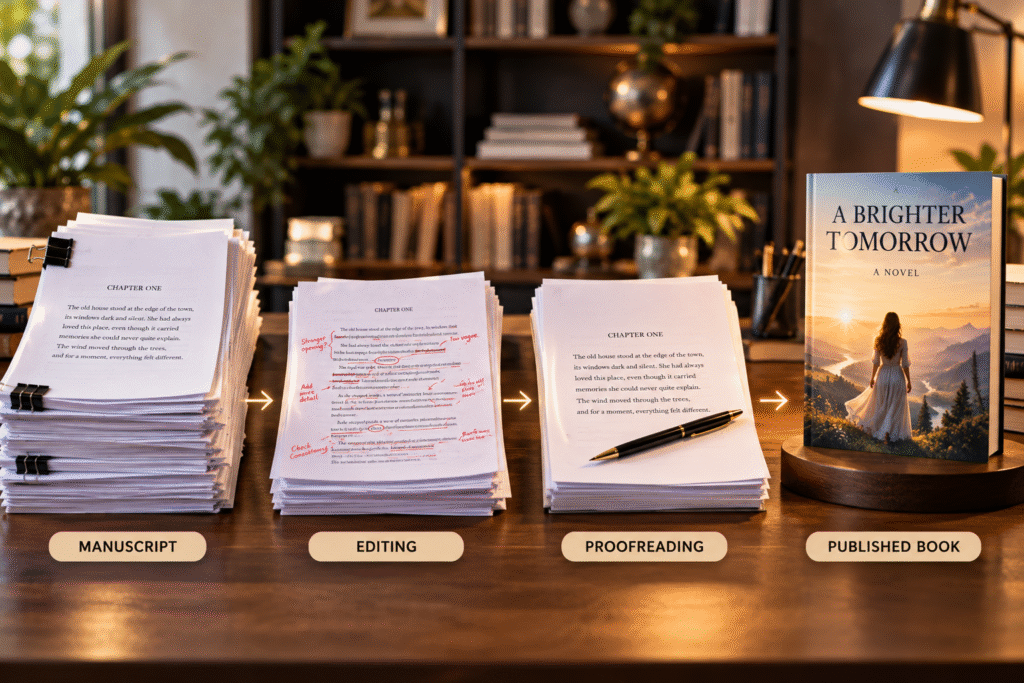
Authors sometimes use the words editing and proofreading interchangeably, but they serve different purposes.
Developmental Editing
Developmental editing looks at the manuscript from a broad perspective.
For fiction, it may examine:
- Plot
- Character development
- Pacing
- Story structure
- Conflict
- Point of view
- Themes
For nonfiction, it may examine:
- Organization
- Argument
- Chapter structure
- Audience
- Clarity
- Information gaps
Developmental editing focuses on whether the book works as a whole.
Line Editing
Line editing focuses on how the writing communicates ideas and creates an experience for the reader.
It may address:
- Sentence flow
- Word choice
- Tone
- Repetition
- Clarity
- Rhythm
- Transitions
The goal is to strengthen the writing while preserving the author’s voice.
Copy Editing
Copy editing focuses more closely on correctness and consistency.
A copy editor may review:
- Grammar
- Spelling
- Punctuation
- Syntax
- Consistency
- Style
- Capitalization
- Terminology
Proofreading
Proofreading is typically one of the final stages before publication.
A proofreader looks for remaining surface-level mistakes after editing and formatting have been completed.
This may include:
- Typos
- Missing punctuation
- Formatting inconsistencies
- Incorrect page elements
- Spacing problems
- Minor grammatical errors
Understanding these differences can help authors choose the right professional book editing service for their manuscript.
How Professional Manuscript Editing Improves the Reader Experience
Editing is not about changing an author’s identity or rewriting the book into something completely different.
Good editing strengthens what is already there.
Professional editors help authors identify areas where the manuscript may confuse, slow down, or distract readers.
Effective editing can improve:
- Clarity
- Readability
- Pacing
- Structure
- Consistency
- Character development
- Dialogue
- Grammar
- Sentence flow
The result should still sound like the author.
It should simply be a stronger, cleaner, and more polished version of the manuscript.
Why Editing Matters Before Publishing a Book
Readers may forgive an occasional typo, but repeated editing problems can affect how they perceive a book.
Poor editing can lead to:
- Reader frustration
- Negative reviews
- Lower credibility
- Reduced recommendations
- Early abandonment of the book
- Weaker word-of-mouth promotion
This is particularly important for independent authors because readers often compare independently published books with professionally produced titles from established publishers.
Your book does not need to be perfect, but it should feel professionally prepared.
When Should You Hire a Professional Book Editor?
Consider professional editing when your manuscript is complete enough that you are no longer making major changes on every page.
Before sending the manuscript to an editor, complete your own revision first.
Read through the book carefully and address any obvious issues you can identify.
You may also benefit from beta-reader feedback before professional editing.
Once the manuscript is stable, an editor can focus on issues that are harder for the author to see.
You may especially benefit from manuscript editing services if:
- This is your first book
- You have completed several revisions but still feel uncertain
- Beta readers are confused by certain sections
- You struggle with grammar or sentence structure
- The manuscript contains complex timelines or characters
- You plan to publish professionally
- You want an objective editorial perspective
How to Choose Professional Manuscript Editing Services
Not every manuscript requires the same type of editing.
Before hiring an editor or publishing company, determine what stage your manuscript has reached.
Ask questions such as:
- Do I need structural feedback?
- Is my story already complete?
- Are my sentences difficult to read?
- Do I mainly need grammar corrections?
- Has the manuscript already been edited?
- Do I only need final proofreading?
A reputable editor should be able to explain which level of editing is appropriate rather than automatically recommending the most expensive service.
You should also understand exactly what the service includes before beginning.
Common Manuscript Editing Mistakes Authors Should Avoid
Even authors who understand the importance of editing can make mistakes during the process.
Avoid:
Editing Only Once
Strong manuscripts usually go through several stages of revision.
A single proofreading pass cannot replace developmental, line, or copy editing when deeper problems exist.
Publishing Immediately After Editing
After major editing, review the manuscript again before formatting and publication.
New mistakes can sometimes appear during revisions.
Depending Only on Editing Software
Grammar and writing tools can help identify certain issues, but software does not fully understand context, character development, storytelling, tone, or author intention.
Technology can support editing. It should not automatically replace human judgment.
Choosing an Editor Based Only on Price
The cheapest editing option is not always the best value.
Look at experience, communication, editing approach, sample work, and whether the editor understands your genre.
Ignoring Editorial Feedback
You do not have to accept every editorial suggestion.
However, if an editor repeatedly identifies the same problem, it deserves careful consideration.
Good editing should be collaborative.
Can Professional Editing Help Your Book Sell More Copies?
Editing alone cannot guarantee book sales.
Marketing, cover design, distribution, pricing, genre demand, author platform, reviews, and many other factors influence sales.
However, professional editing can help create a stronger product.
If marketing brings readers to your book, the quality of the reading experience helps determine what happens next.
A professionally edited book is more likely to:
- Hold reader attention
- Build credibility
- Encourage recommendations
- Generate stronger reviews
- Strengthen the author’s reputation
Editing should therefore be viewed as part of the overall publishing process rather than an isolated final task.
Manuscript Editing Checklist Before Publishing
Before publishing, review your manuscript for:
- Plot or structural problems
- Pacing
- Point-of-view consistency
- Character consistency
- Timeline accuracy
- Repetition
- Unnatural dialogue
- Sentence clarity
- Grammar
- Spelling
- Punctuation
- Formatting consistency
- Missing words
- Duplicate words
If possible, complete these checks at different stages rather than trying to correct everything in one reading.
Do Not Let Editing Mistakes Undermine Your Book
You have already invested significant time, creativity, and effort into writing your manuscript.
Do not allow avoidable editing problems to weaken the final reading experience.
Professional manuscript editing can help identify problems that are difficult to see when you have been working closely with the same material for months or years.
The goal is not to remove your voice.
The goal is to make your voice clearer.
A carefully edited manuscript gives readers a smoother experience, strengthens the professional presentation of your book, and prepares your work for the next stage of publication.
Need Professional Manuscript Editing?
Virtue Publishing provides professional manuscript editing services for authors preparing fiction, nonfiction, memoirs, children’s books, and other manuscripts for publication.
Our editorial support can include developmental editing, line editing, copy editing, and proofreading based on the needs of your manuscript.
EXPLORE OUR EDITING & PROOFREADING SERVICES